Rent is the line everyone talks about, and rightly so: in Amsterdam it often swallows half a net salary. But it is everything else that decides whether you live comfortably or count the days to payday. Here are the figures as we see them among the people we work with, in 2026.
The number that matters: net income after rent
A common mistake is comparing a Dutch gross salary with a gross salary at home. The two systems tax different things in different places, and the comparison only means something after tax and after rent.
Take your net monthly salary, subtract the rent including utilities, subtract health insurance. What is left is your real budget. For a couple earning €3,200 net each and renting a two-bedroom at €2,500, that leaves roughly €3,600 to live on between two people. Comfortable. For one person on €3,000 net in a studio at €1,850, around €950 remains after health insurance. Workable, with no slack.
Our real-cost calculator runs this from a specific rent, adding the lines listings never mention.
Groceries and eating
Budget €250 to €350 per person per month for groceries, more if you buy a lot of imported food.
- Albert Heijn is everywhere and convenient, and the most expensive. The Bonus card is free and makes a real difference.
- Lidl, Aldi and Dirk cut 20 to 30% off the same basics.
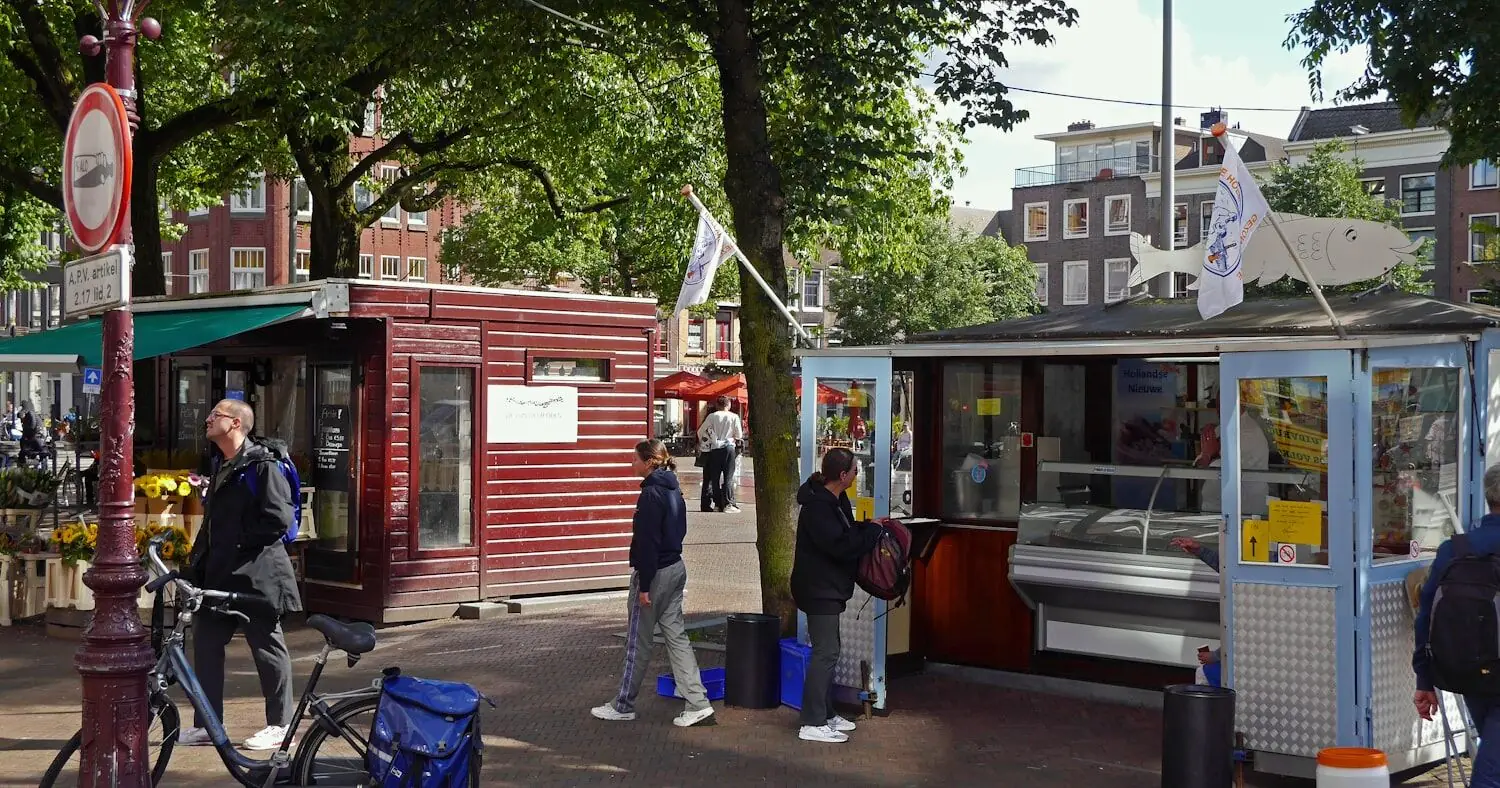
- Markets (Albert Cuyp, Dappermarkt, Ten Katemarkt) are markedly cheaper on fruit, vegetables and fish.
- Toko and Turkish, Moroccan or Asian grocers: the best prices on spices, pulses and fresh produce.
Eating out stays expensive: €15 to €22 for a decent main, €4 to €5 a beer, €3.50 a coffee. Lunch on the go runs €8 to €12.
Energy, water and internet
These depend less on your habits than on the quality of the building. That is why the energy label appears in listings, and why you should look at it.
- Well-insulated studio or small flat (label A-B): €100 to €160 a month.
- Average two-bedroom (label C-D): €180 to €280 a month.
- Large older home (label E-G): €350 to €500 a month, with winter spikes.
- Fibre internet: €40 to €55 a month depending on provider and speed.
A poorly insulated home can cost €200 more a month than a recent one at the same rent. Over a year, that is more than a month's rent.
Local taxes, the ones nobody advertises
In the Netherlands part of the local taxes are owed by the occupant, not the landlord. They arrive by post a few months after you move in, and they catch almost every newcomer out.
- Afvalstoffenheffing (waste collection): from about €350 a year per household.
- Waterschapsbelasting (water authority): roughly €240 to €450 a year depending on household size.
- Drinking water: metered, around €15 to €25 a month.
All in, allow €50 to €75 a month for these three lines.
Health insurance: compulsory and individual
Anyone living or working in the Netherlands must take out basic health insurance, and it is individual: a couple pays twice. Budget €142 to €185 per adult per month, plus an annual excess of €385 that you only pay if you use care. Children under eighteen are covered free.
How to choose, and what the options change, is in our zorgverzekering guide.
Getting around
This is where Amsterdam is markedly cheaper than Paris or London, because most daily journeys happen on a bike.
- A decent second-hand bike: €120 to €250, plus a serious lock (€40 to €80, do not economise here).
- GVB travel pass: about €100 a month unlimited, though most residents take a partial pass or pay per journey.
- Single journey: €3 to €4 by tram or metro with a contactless bank card.
- A car: resident parking is expensive and the waiting lists run into years in the centre. Most of our clients give it up, and do not miss it.
What setting up costs, once
The first year carries expenses that will not come back. Better to know them before you leave.
- Deposit: usually one to two months' base rent, returned at the end of the lease.
- First month's rent, due at the same time as the deposit.
- Furnishing: from €2,000 for a gestoffeerd studio to €8,000 and up for a kaal home to fit out entirely. See our guide to furnishing a home.
- The move itself: €800 to €2,500 from elsewhere in Europe, depending on volume.
- Bike, kitchen kit, curtains: the small lines that quickly total €500 to €1,000.
Three worked budgets, all in
Here is what three profiles we often work with actually spend, month after month. Rent, utilities, taxes, insurance and daily life included.
- Student in a flat-share: €1,250 room, €90 utilities, €145 insurance, €280 groceries, €150 social life and transport. About €1,900 a month.
- Young professional in a studio: €1,850 rent, €140 utilities and taxes, €155 insurance, €320 groceries, €300 going out, leisure and transport. About €2,750 a month.
- Couple in a two-bedroom: €2,500 rent, €260 utilities and taxes, €310 insurance for two, €550 groceries, €500 daily life. About €4,100 a month.
These assume a home inside Amsterdam. A neighbouring town cuts the rent line by 20 to 40%, which changes everything downstream: that is the subject of our guide to living around Amsterdam.
The levers that actually move the total
In order of effect, heaviest first.
- The neighbourhood. The same flat costs €800 a month less in Nieuw-West than in the Jordaan. By far the biggest lever: see our neighbourhood guide and our matcher.
- The energy label. An A rather than an F is €200 a month in winter.
- The 30% ruling, if you qualify: it changes the net radically. See our 30% ruling guide.
- A bike instead of a travel pass: roughly €1,000 a year.
- Shopping outside Albert Heijn: €60 to €100 a month for a household.